Sunday, 15 November 2015

risk assessment


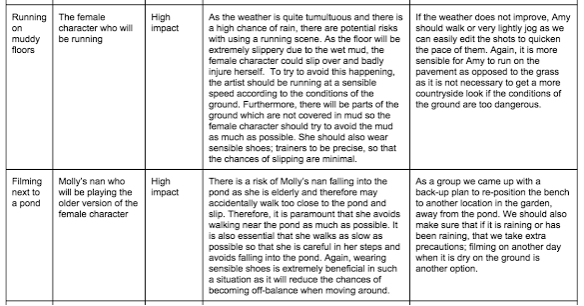
The purpose of risk assessment whilst participating in production of any media piece is to simply review a situation in the process of production, i.e. filming a particular scene, and seeing if there are any risks involved in order to maximum the reduction of any accidents. Risk assessments are a filming requirement and aid in forming a beneficial health and safety regulation to adhere to in all situations. Therefore, any hazards and risks can be made aware of as well as identifying exactly whom is at risk; in this case, is it the actors/actresses or filming crew? Risk assessment also helps to establish what the most appropriate measures that must be taken are. During the risk assessment process, we have laid out a plan B so that there are no hindrances during the filming and therefore we can stay on schedule. Having a risk assessment will ensure that everyone in the group is aware of any potential dangers and will immediately know the alternative and rectifying course of action to take. 


Conclusively, my group and I did largely follow our risk assessment as much as possible. As we were already aware of any potential dangers, we will be continuously trying to take precautions whilst filming to reduce any problems as much as possible. For example, for the performance scenes where we used candles, we came prepared to the filming location with battery candles as well as real-life candles as we were aware that there could be high-risks. During the filming of the London scenes, I took a friend with me to help with the filming. This was actually extremely useful for me as she helped with keeping an eye on the equipment whilst I tried to look for good locations which were less-populated. However, there were some issues during filming. For example, during the running scene, there were weather issues such as high-level of winds; this caused the equipment to be knocked over. Therefore, this became an obstacle for Amy whilst she was running and was exceedingly dangerous. We quickly came up with a solution for this issue; someone who was not in charge of a particular shot would ensure the tripod is stationary throughout the filming. We also had an issue with the weather affecting the camera; as it it is not waterproof and it was raining, there was a risk of the camera not working any more. In addition, water drops kept getting on our camera lens and therefore obstructing the quality of the visuals. Therefore, we were forced to reschedule. The weather itself was the main risk through our entire production. A lot of the other risks that we mentioned did not pose to be an issue as we ensured that we took precautions to prevent any risks from occurring. Whilst filming the performance scenes that used candles, we still used the fire candles as opposed to the battery candles as we took measures to avoid any risks: we places them in the centre of the top of the piano with nothing inflammable around them. Overall, the risk assessment was extremely helpful as it reduced any risks as much as possible.

Friday, 13 November 2015

filming schedule


A filming schedule is important to have it is a way of effectively organizing yourself in order to create a more successful music video. Having a schedule means that you can set yourself targets to achieve by a specific date and therefore you will get a lot more done. These targets can be set for the group as a whole as well as individually as different members of the group can be allocated different responsibilities as to what they are filming. In my own group, we shared out the role of filming specific scenes as we recognized the practicality and efficiency of doing so. As Molly lives in Debden, very close to Theydon Bois, one of our filming locations, she took on the role of filming the scenes in this area, such as when the couple first meet. Similarly, Claire was given the responsibility of the performance aspect of the music video as she actually owns a piano in her house. My own duty was directed towards filming the shots of London which will be edited to be placed in a time-lapse. As you can see, sharing out responsibility according to a specific schedule is a far more effective approach than everyone doing each task together when not everyone is actually needed to do this. Furthermore, the filming schedule will help us when we film as we will remember exactly needs to be included in the specific scene we are going to film on a specific day; this is crucial as it is a headache and time-wasting to forget things. In addition, having the filming schedule there ensures that you take precautions in checking for the weather forecast or any other factors which may affect the filming on a specific day you have scheduled.


Ultimately, my group and I did closely follow the filming schedule as much as possible; all the locations mentioned above were used, alongside all the correct shots and iconography. Molly shot the scenes in Theydon Bois with Amy and Morgan - the two characters - on the day we planned, as this is one of the first shots of the video and was quite easy to film in regards to the nearby location, the availability of the two characters and the weather. As this was the first meeting of the two characters that would be seen in the video, we wanted to ensure the weather would fit the scene; we did have a back-up plan in case of a downpour, however if it were sunny - even if mildly - it would be preferable as it would match the happy and innocent mood we desired for a first encounter. The date we put for filming the performance aspect of the video also stayed the same as Claire was available at this day; availability was our only concern as we did not have to worry about other factors such as weather. However, despite our efficiency of keeping to schedule, we actually realized that these scenes would be needed to be re-filmed as due to the darkness of the room, the shot came out looking grainy and of low-quality. Therefore, instead of shooting the scene in low-key lighting, we decided to shoot it at a brighter period of the day; it is easier to shoot a scene in high-key lighting and then just reduce the lighting brightness when we get onto editing. We set a date to re-film these scenes for the 13th of November. My own responsibility was for shooting the scenes of London and I was actually able to go ahead of schedule and film them on the day before we planned out as I was going up to London with a friend and therefore was able to use this opportunity to film the sights. However, we did run a little off schedule; one example is when we had to change the day of filming the scene of Amy running as the weather conditions meant that it was extremely muddy and therefore it was too unsafe for Amy to run in. Even if we tried to be cautious in filming, there was still the danger of Amy falling and therefore we did not want this to happen. In addition, as it was still raining, Amy would have preferred to run when she would not get wet. Furthermore, the camera lens would have gotten rain-drops on it and this would have obscured the visuals produced from the camera. Therefore, Molly re-filmed these scenes on the following day when the weather conditions were much more suitable. However we also had the issue of trying to fit in our filming schedule with Amy's filming schedule as she has to participate in her own group's music video production. There were one or two occasions where our schedule clashed and we actually had to re-schedule for the following week which hindered on our own schedule. Overall, I think my group and I did a very proficient job of keeping to schedule, and if there were times when we drifted away from it due to external factors, we managed to quickly use our back-up plans to get us back on track.

However, if I had the chance to plan and record the production of the music video again, I think I would have planned out more narrative scenes, to cut between the performance scenes. From watching indie music videos for inspiration and research, I liked how a lot of them use quick cuts between performance and narrative scenes; whereas in specific parts of my group and I's music video, we used quick cuts between performance shots, making the performance aspect seem more dominant than the narrative. The reason for this is that we actually filmed a lot more shots than we needed. As we wanted to ensure we had backup footage we actually over-compensated the amount of filming. During the filming of the performance aspect of the video, we filmed chunks of the song but from different angles and positions in order to cut between them in the editing, so the video would be far more interesting than if it was all from one angle. Overall, having a filming schedule has been exceedingly beneficial for my group and I as we were able to be organized and precise in our production. If we did not have a schedule we would be wasting a lot of time deliberating over what to actually film and then what we have already filmed and what is left to film. 

Sunday, 8 November 2015

music video storyboard


The purpose of a storyboard is simply to plan out the individual shots that you will need to take when you film your video. Creating a storyboard before you start filming is exceedingly beneficial as it saves time as you know exactly what you are doing. In addition, a storyboard will reduce the chance of your shots being incoherent and unusable; if you do not know what exact shots you want to take and just take random ones, they may not fit together when you get to editing. It also means that you will know what costume and props from the iconography to use for particular shots when filming. Creating a storyboard means that you can show other people precisely how the music video is going to be made and you can coherently talk about the video in detail. Production of the music video will be incredibly easier as it ensures you will not forget any necessary shots you need to take; it also is beneficial for when you are editing as you can put the video together in the correct order. Furthermore, if you have only planned some of the shots for the video and have started editing them, you will know which ones you have left to film and therefore it saves time.


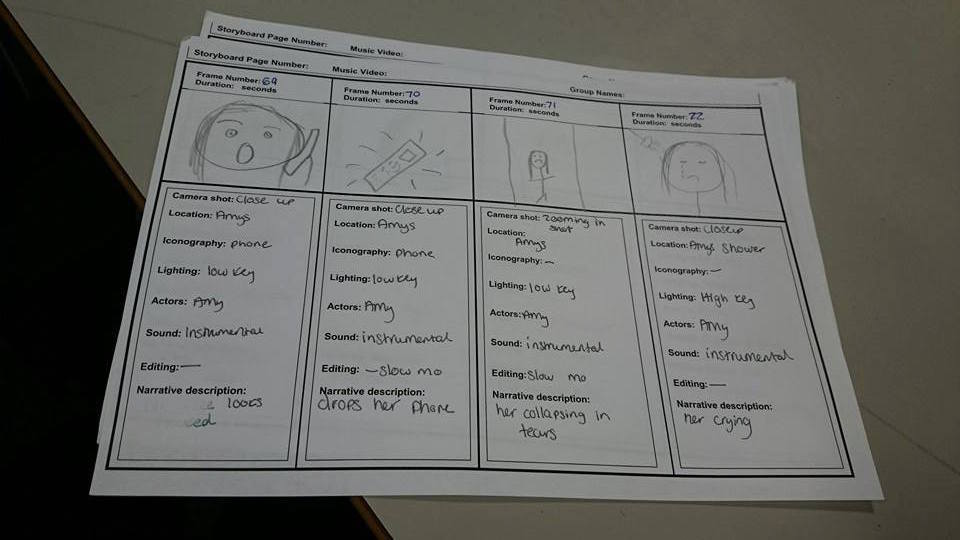
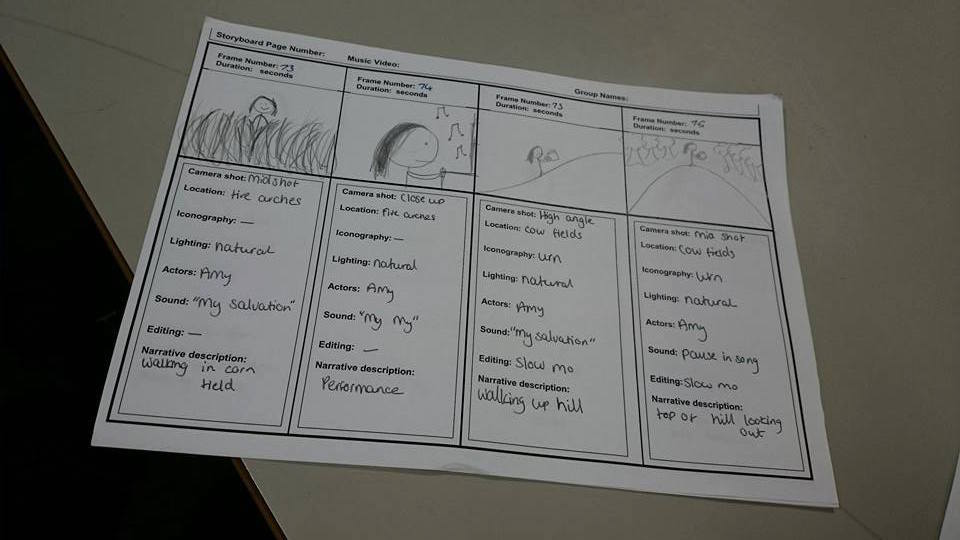
Below are pictures of all the pages of my group and I's storyboard. As you can see, there are quite a lot of pages as we planned out every single shot in detail so that when it came to filming, we would be completely prepared and not be wasting time trying to figure out how to take the shot or forget to bring the necessary props/costume etc for the shot. We did actually forget to color in the storyboard images which would have helped in quickly knowing what the costume will be. We have decided to use the same scene we have used at the beginning, at the end as well. This is simply due to the fact that it gives a better finish and allows the audience to connect what they have initially seen to the rest of the narrative and answers any questions they may of had at the beginning of the narrative.


To plan the music video for the song "Salvation", I had to use both my primary and secondary research that I carried out previously. The primary research I carried out by producing a questionnaire relevant to the music video advocated in the planning of the music video as it allowed me to gain more insight into people's preferences of what should be in the music video. For instance, within the questionnaire, we asked 40 people whether they prefer indie artists who play musical instruments in their music videos; 47% said yes, whilst only 40% said no. Taking this information, my group and I decided to incorporate a musical instrument into our own music video which is why we allocated specific parts of the song to the artist performing the song. Many other aspects of the video have been taken from my research; the vox pops also aided in helping to provide inspirations. One of the questions on the vox pops was asking whether the audience participant prefers the location of the countryside or city; more people said the city and therefore we decided to incorporate shots of London in our video. In order to make it more obvious it was the city, we planned out various locations such as London Bridge, Oxford Street and Covent Garden. As this is an indie love story, using London shots would subvert some of the conventions of the genre and therefore appeal to the audience more as the video will be more unique. Overall, the primary research helped to plan out a more successful music video as the majority of my group and I's decisions were shaped around the audience's answers given in the questionnaire. 

We also had to carry about secondary research of gaining inspirations from other artists of the same genre. As my group and I's artist belonged to the indie genre, we focused on artists such as Ed Sheeran, Tom Odell, Nina Nesbitt, Birdy and of course, Gabrielle Aplin herself. From looking at Gabrielle Aplin first, we noticed a trend in her look; she prefers a minimal look, with more casual-style clothing and natural makeup. Therefore, for our own artist, Amy, we wanted to keep the costume and makeup planning as low-key as possible as the audience want the artist to be extraordinary enough that they can aspire to them, yet if the artist wore designer clothing and a lot of makeup, it would not fit the genre, but rather come across as quite mainstream. My group and I also noticed that artists such as Gabrielle Aplin, Birdy and Tom Odell all played musical instruments in their video. The song we picked, "Salvation", featured an instrumental of a piano and as Amy could actually play it, we decided to definitely feature one. In addition, as stated previously, in our primary research of the questionnaires we carried out, more people mentioned that they do like to see the artist playing an instrument and therefore it was beneficial to include this performance aspect in planning the storyboard. This also helps to maintain that extraordinary perception the audience has of the artist, as it is important that they can take something from the music video, otherwise it appears quite boring. Another inspiration we took from our research into the indie genre was the different shot types that many artists used. In Birdy's music video for "Skinny Love" she is shown playing the piano; as we wanted to have Amy playing the piano as well, we looked into this video in depth. We noticed that even though there was not much occurring in the performance aspect, expect the artist playing an instrument, it was still quite interesting to watch as the shots never stayed the same for more than three seconds; the range of extreme close ups, to mid-shots and wide shots from different angles of behind and to the side, kept the performance aspect exceedingly refreshing. Therefore, we ensured to employ the same variety of shots in our own music video. We planned out extreme close up shots such as Amy's foot on the pedals of the piano, or her fingers playing the keys, etc. This way, our music video would be perpetually interesting for the audience.

My group and I started off storyboarding our music video by analyzing the lyrics of our chosen song, Salvation. We did this so that the shots we chose made complete sense and actually matched what Gabrielle Aplin was writing about. However, we evidently did not copy out the literal meaning shot by shot as firstly, many meanings could be taken from the lyrics and secondly, we wanted to make the video as unique as we could. There were some lyrics that we thought had connotations of death, such as "glorious we transcend into a psychedelic silhouette", which matched our narrative, as the male protagonist actually dies at the end of our music video. Analyzing the lyrics meant that it was a lot easier to come up with a coherent and interesting narrative with a lot of ideas of shots so that we do not run out of things to film. We then started writing out each individual shot that is going to be included and in the correct sequence. The reason for doing so is to we know the correct order to put all our shots in when we start editing the filming. To help keep track of the number of shots we would be taken and how long each shot would be, we ensured to include the framing number and the duration of each individual shot; this enabled us to keep track of how many minutes of the song we have taken up. Consequently, we nit-picked over the very necessity of the shots to include as our timing was limited. Within the storyboard we also included images to give a rough idea of what the shot will look like. Drawing images to match the shot type is exceedingly useful as it helps with visualizing the shot and therefore when we get to actually filming the video, we will be able to quickly set up the scene to match the storyboard. During filming we would be referring back to the storyboard frequently and therefore it was vital that we put as much visual information on it as possible to avoid any confusion. Therefore, the actual writing we included in the storyboards has been selected in a particular way; along with the basic information such as the shot type, the editing style, the lighting, the location and iconography, we have also expanded on details by giving information about the actual narrative content and the sound (the lyrics) that will go along with the shot. This is exceedingly beneficial for keeping the narrative and performance parts of the video in time with the music and the lyrics. The artist will be showing performing the song and therefore she must be both singing the song and playing the piano completely in time. The storyboard will aid in doing so as it will show which parts MUST be shown at a specific time according to when a particular line of the song is sung.

The creation of the storyboard was a group effort; we started the process during class and therefore had the opportunity to work together on it. We all put input into our thoughts as to how long we think each shot should as keeping the duration to a specific timing can be difficult when there are a lot of things you want to include. However, as we did not finish the storyboard during class time, Molly decided to stay on and complete it during the next hour after class as she had a free period. She finished writing out all the information and then Claire and I finished off the drawings to accompany the relevant shots. Before we actually started creating the storyboard, we first discussed how to best approach it. First, we referred back to the lyrics that we analyzed as our annotations aided in acknowledging where each shot will be and all the different misc-en-scene components that will be included in each one.

Overall, my group and I followed the storyboard to nearly exactly how we produced it. This is due to the fact that we created the storyboard so well and detailed that it needed minimal changing. However, there were some instances in the storyboard where shots were moved around a little. For example, the London scenes we decided to put it had to be fiddled with a little in order to match the scenes before and after it; in the storyboard, there were some parts where the London scenes did not actually match and we only realized when we started filming and put the shots together. There was also the issue of natural lighting and weather conditions. During planning our storyboard out, we did obviously take into account some factors that may affect our filming. However, we did not anticipate the quality of the filming indoors if it was dark outside. For example, for our performance scenes where Amy is playing the piano, we played to film it in low-key lighting, with just candles providing our lighting. As we filmed these scenes when it was not particularly light outside, the quality of the footage was not brilliant, as the lens gave a grainy looking effect to the visuals. Therefore, we had to rethink this and instead of turning off the lights, and filming when it was dark outside, we still used candles, but just turned on the lights in the room. This is simply as the candles were essential to the music video, however we could simply edit the footage to make it appear darker; it is better to film during lighter conditions as the quality will not deteriorate when you edit it to make it darker. There was also another obstructing factor: the weather conditions affected the day we could film the scene of Amy on a run. As it had rained on the previous day to filming and it was still raining when we got to filming, there was a hazard of Amy running as she could have slipped and hurt herself badly. There was also the risk of the camera getting wet; therefore we had to reschedule the day we filmed this scene as we did not anticipate the weather conditions. However, I do think that our storyboard was ultimately a success as we ensured to use maximum detail to minimalize any issues.

Saturday, 7 November 2015

planning individual magazine advert


The prime importance of a magazine advert for a music artist is simply to promote themselves and their music as much as they possibly can. Adverts are displayed all around places such as bus stops, tube and train stations, and billboards. Therefore, a large and wide range of people would be constantly viewing the advert and therefore it is more likely they will search up the artist's upcoming album and share it round with their friends; this helps promote the artist further and they will make more sales. In addition, this method of advertizing helps the artist to reach a larger number of their target audience; for example, for Gabrielle Aplin, she would want 15-25 year olds who enjoy the indie genre to notice the advert. Magazine adverts also creates synergy between the artist and another company as the latter will help advertize and promote the artist and their music; if the artist is featured on a magazine, there will most probably be an interview to coincide with the feature and therefore the audience can go learn more about the artist. I myself will be creating a magazine advert for my artist, Gabrielle Aplin. As I am producing a indie genre music video, my magazine's codes and conventions must be a reflection of this. To make the advert, I first needed to plan out the design I will choose and what will be featured. Planning is crucial as it provides a clear basis for laying out initial ideas which you can later on adapt or remove if appropriate. The plan version of my advert will act as a guide to what I will later create and allow me to put down as many different ideas all on one paper and then see what works best.

My magazine advert has been made for Gabrielle Aplin's album "English Rain", which my group and I have changed to "Desolation" and used the artist name "Amy-Michaela". However, there are still various elements I have kept similar to Gabrielle Aplin's style. For example, the typography I have opted for is the same as the one Gabrielle Aplin uses in her album. In my actual magazine advert I will be using the artist name "Amy-Michaela", however in my plan I forgot to change her name. I have decided to use the same typography as it is simple yet still interesting. However, when I make the real magazine I will slightly alter it so that I do not completely copy the original idea. It is conventional of the indie genre to not be elaborate in their design as the music itself is simplistic and therefore it is a reflection of the artist's authenticity. This is more appealing for the target audience as they will subliminally expect to see certain aspects within the magazine advert; if they see an extremely extravagant design and font used then they would not appeal to the advert as much as it does not conform to the indie conventions; therefore they would be be less likely to buy the album. Furthermore, using a simple font means that the audience can aspire and relate to the audience more easily which is a more appealing for them. However, it is also beneficial in representing the artist as being quite deep in the aspect that there is a plain and simple surface portrayal of the artist yet underneath the front cover, within the music, there is much more to the artist than meets the eye. I have also kept the typography of the album title the same as Gabrielle Aplin's in my draft; however, I again will alter it slightly when producing the real magazine advert to fit more with the main image and theme of my magazine. I have also chosen to keep the language I have used in the magazine simplistic to again reflect the simple nature of the music and genre. Having more information on the magazine advert would give it an unconventional cluttered effect which would not appeal to the audience. Furthermore, a lot of people who read magazines would scan the front page first before purchasing it as they first want to see if they find it interesting. If there was a lot of information on it then the audience would not be particularly interested in buying it as they only care for the succinct main information and nothing more. Therefore, in my own magazine advert I have only included three of the singles included in the album which would be more well-known to the public and therefore attract them into purchasing the album. I have also given a list of the platforms in which the audience can listen to the album which would be useful if they want to quickly find the type of album they are looking for. My target audience consists of 15-25 year olds; this age group in specific certainly do not want to be reading complex and long language as they will quickly become bored; my magazine advert needs to consistently adhere to the needs of my target audience. The actual choice of words I have opted for are also extremely crucial; words such as "acclaimed" to describe the singles included in the album help to portray a positive and successful image of the album and encourage the audience to buy the album. It is more effective to use short snappy sentences with positive words to grab the audience's attention, rather than long, figurative language that bores the audience by not quickly getting to the point. The language used is also beneficial in presenting the actual music itself; the artist's music is shown to be more focused on the quality of the music rather than the quantity or anything else. The target audience would evidently appeal to this idea as they themselves would thoroughly enjoy the indie genre who uphold the convention of focusing on the substance rather than image. 

In addition, I have also thought about the layout and design of the magazine as this is exceedingly important in shaping the whole magazine for the eyes of the audience. I have focused upon the alignment of everything in the advert; the album title and the artist's name has been copied from Gabrielle Aplin's album as I liked how due to its central positioning, it drew the eye directly to it. Furthermore, as it is at the top of the page, the audience can quickly and coherently read it to know who the advert is about and aimed at. This also means that there is a lot more room to include anything else needed as the titles are out of the way. Therefore, as I had three-quarters of page room to use, I decided to have the main image fill up nearly the entire page. This is effective as it means that it is completely clear for the audience to look at. The actual image features a girl on the road, with her back to the camera yet looking directly at it. I purposely chose to use every one of these elements as I wanted to create deeper meanings and connotations. The use of the girl on a road creates enigma codes within the advert as the audience are left wondering who she is and why she is all alone on a road, at night time. I chose to use a road as it has a deeper meaning of the journey that the artist is going on. Having the artist with their back to the camera except their face will suggest that she is quite mysterious yet is inviting the audience into knowing more about her. In addition, I have chosen to use an image of the artist during the night as the dark natural lighting accentuates the theme of mystery and invites the audience in from curiosity to know more about the artist. The image will help to attract the audience as it closely follows the indie genre conventions; indie artists tend to not use close up images of their face as they do not focus on themselves but rather their music and creating meanings. I have also included the Parlophone company name and logo on the top left hand corner; despite it being small, I wanted to include it to establish where the artist is signed to as it is part of her and her music. It also helps to promote her as if the audience want to find out more about her, they can go to Parlophone's website and find out more. In addition, I put it in Amy-Michaela's website on the bottom right hand corner; again, I put it in small print again as it is important but merely an afterthought of importance compared to the rest of the text. Including the website means that the audience have a platform where they can find out more about the audience and therefore engage with them more. Therefore, the audience can be promoted further this way as it establishes them as being quite successful as they have their own website.

Within the image, I have focused on limiting the amount of color I will use in my magazine advert. It is conventional of the indie genre to not use a lot of color, particularly bright colors; they tend to use more neutral colors. I have focused on greens and browns, with the addition of shades of blacks/greys. Greens and browns are more earthly colors and reflect the convention of indie music to use countryside locations within their music videos. This helps to maintain the authenticity of the artist and their music. Using blacks and greys is helpful in creating the enigmatic aspect to the magazine advert. In addition, I have purposely eluded using whites or creams, a convention of the indie genre. I want to subvert the conventions of representing the artist as innocent as possible as the color white connotes purity and innocence, whereas black is the opposite. However, to not go too against the indie conventions, I plan to have the artist wearing a costume of more beige or cream colors to juxtapose with the dark natural lighting in order to maintain the idea of the artist being quite an ambiguous and complex character. This is more appealing for the audience as it allows them to become an active audience and actually try to interpret the artist in their own way and truly engage with them, instead of just accepting everything given to them. The indie genre conventionally rejects escapism which audiences in the other genres, e.g. pop, focus more on as the audience and artist are placed on similar levels to each other. Although I have laid out a specific color scheme, I do not wish to use filters within my magazine; if I do, they will extremely subtle. This is simply due to the desire to conforming to the indie convention of keeping everything as genuine as possible; heavily filtering the image will add in a strong degree of artificiality.

From previously analyzing a magazine advert for Gabrielle Aplin, I had more awareness of what to include in the planning of this magazine advert. Gabrielle Aplin's magazine advert gave me inspirations as I wanted to create something unique yet simplistic, like her's.  I also took the idea of using greys and blacks as it gives a more powerful deeper meaning than simply using a plain color such as just white. I liked the idea of there being a juxtaposition between dull and miserable colors, with brighter colors. I will incorporate this inspiration into my own magazine as I will use greys and blacks for the background with dark natural lighting and increase the saturation on the trees. However, looking at Gabrielle Aplin's magazine advert also gave me an inspirations due to lack of what she has not included. For example, I included in the use of ratings from two music magazines - NME and Billboard - as this would help promote the artist even further by demonstrating that although this is her debut album, she is extremely successful. Therefore, the audience will find the magazine more appealing and be more inclined to read it and buy the artist's music as they know highly placed companies have rated it extremely well. 

From doing extensive research into other indie magazine adverts, I have been able to create a more successful advert of my own, as I am aware of the indie codes and conventions that the target audience appeal to. This way, my magazine focuses on what the audience want to see and will appreciate, allowing a more personal relationship between the artist and audience to form as the artist has taken the audience's needs into consideration. For example, choosing an indie location is extremely crucial when promoting the artist and their album and helps to engage the audience as they are automatically aware of the genre of music they are seeing. Furthermore, I had to ensure to take the layout of the magazine into deep consideration, as from looking at other magazine adverts, from both the indie genre and other genres, I can see what sets the indie genre apart: the image of the artist should not take up the most room nor be right in your face. Gabrielle Aplin's magazine advert inspired me to make the artist prominent in the magazine but not the sole focus. Instead, I have focused on how the different elements, such as the color, can say more about the artist an their music than an image of the artist themselves. For example, the use of a night-time image with the artist's face more illuminated creates deeper connotations about the artist's emotions and what the content of the music could be like; I think this has made my magazine more successful. In addition, a better relationship between the artist and audience can be formed as the audience can see that a lot of thought has gone into the construction of the layout. Furthermore, as the magazine advert is quite different to what the audience may usually see, in regards to the use of a night-time setting, they may find it more refreshing as it is unique, and thus be more appealed to the artist and their music.

In relation to taking pictures for my advert and preparing for the use of Photoshop, I found this research quite useful. The research has aided me in coming up with an extremely successful and relevant image that matches my music video; I had a range of ideas and picked the one which I thought held the most meaning and uniqueness to it. Knowing what image I will use and the colors I will include will help with preparing me for using Photoshop as I will focus on the most important elements I need in the software. Planning the magazine advert has advocated in awareness of pictures needed as when I am filming with the characters in the music video, I will know what pictures I want to take with them right there. I will know what I want the characters to wear or how to stand and what facial expressions they will be wearing, etcetera. Therefore, now that I have planned out my magazine advert I now feel more prepared to create it and to ensure I will conform to and subvert particular indie genre conventions that I would like to.


Saturday, 31 October 2015

planning editing styles


The most evident reason for the need of a variety of editing styles within a music video is simply to keep the audience entertained. If the audience were watching a video with the same editing techniques used throughout, they would quickly become bored and would want to continue watching. Sticking to the most basic editing styles such as continuity editing does not achieve much; continuity editing is used to create verisimilitude, therefore it does not "WOW" the audience or make them aspire to what is being shown as it is a realistic perception and therefore a boring perception. Another reason is simply to give the music video a coherent structure so that if we wish to use analepsis or prolepsis within the video then using different editing styles will make this clear; e.g. editing a scene with a black and white filter may signify it is in the past.        


One editing style my group and I chose to use within our music video is slow-paced editing. We have actually decided to employ this style throughout the entire of the video, with the exception of the London scenes which will be in a time-lapse; another editing style we have chosen. The contrast between the fast-paced shots of the city and the slow-pace of the rest of the scenes in more countryside locations, will be crucial in illustrating how the artist is feeling. Slow-paced editing is useful for highlighting sadness which is a key emotion for our narrative. In certain scenes, such as when the last chorus of the song is sung, after the male character has died, slow-paced editing will be extremely noticeable and fitting. The editing will provide a dragged out feeling to the last chorus; therefore both the artist's and consequently the audience's sadness towards the death will be extremely prolonged, effectively creating a more impacting video for the audience. In addition, the repeated lyrics of "my salvation, my, my" in the last chorus will add to the desired dragged out effect and will make the mood of the video even more depressing. This is conventional of the indie genre as often the lyrics exhibit a sense of loneliness or depression as this really allows the audience and artist to connect on a personal level. Furthermore, the indie genre like to write about matters which are relevant to their audience; relationships and break-ups are something which a lot of people go through and therefore enhances the audience-to-artist relationship. In addition, slow-pace editing is conventionally used in order to create this effect; the lyrics are quite slow and melancholic and therefore it would look rather strange to have faster-paced editing which does not match the lyrics or the beat of the music. Slow-paced editing is also effective in representing the artist as being more ordinary than extraordinary and therefore more relatable for the audience. Gabrielle Aplin is seen less as a celebrity who is unreachable but more as someone the audience can relate to, look up to, and take advice from when they are faced with similar problems in their own lives. The GIF image above demonstrates slow-pace editing; in this example, there is a use of slow-pace editing that takes one shot into another shot through a fade. I put this example in as during the beginning of my group and I's music video, we came up with an idea to use slow-pace editing to fade an image of the artist when she was old into a shot of the artist in the flashback the video is set in.

However, in contrast, the fast-paced London scenes will provide a sense of claustrophobia and chaos. This is effective in accentuating the artist's emotions; particularly those of feeling trapped and lost. However, we have also decided to slow down the shots we have taken of London; for example, during the instrumental parts of the song, the slowness of the music in addition to the slowness of the shots will provide more insight into how the artist is feeling. As stated previously, the use of slow-motion is extremely conventional of the indie genre as it emphasizes emotions the characters, particularly the artist, is feeling. Slow motion is also conventional as it gives more time for the audience to focus on a particular aspect of importance for the artist. Indie music videos tend to put certain objects or situations at focal points as it adds to the narrative. The fast-paced time lapse will be useful in representing Gabrielle Aplin as being quite extraordinary, with a typical celebrity style busy lifestyle. This makes her more unattainable for the audience as she is not as relatable; fast-paced editing is not conventional of the indie genre. The GIF image above gives an excellent example of fast-pace editing; as you can see, this technique is beneficial when desiring a dramatic effect. I want to create the same impact in my own music video and therefore will use fast-paced editing so the audience are aware of the change in the artist's emotions.


Another editing style which we have chosen to adopt are the use of jump cuts. This is due to the fact that this type of editing will allow us to effectively transition from the narrative to performance parts of the music video. Evidently, we do not want the music video to look strange and unprofessional if the types of the scenes keep changing and therefore by using jump cuts, it will be clearer that the narrative and performance parts are related. One example of where we would use a jump cut is after the artist sings the lyrics of "bring me back around again", the scene changes from narrative straight to performance. The use of a jump cut here will demonstrate to the audience that the artist is being shown in two different lights: the performance aspects are more personal as she is all alone and the narrative is to give more to the audience of what the artist is like. This is more effective than just having pure narrative or pure performance as it represents the artist in more than one way; the audience want to get to know the artist as much as possible. Furthermore, the jump cut can be used as a metaphor to illustrate the tumultuous life of the artist; the constant changing between narrative and performance gives more insight into what the artist's life is like personally as well as perhaps on a more celebrity status level. Relating to Dyer's theory, the use of jump cuts are effective in representing the artist as quite extraordinary as it shows how multi-talented she is; the music video illustrates Gabrielle Aplin as singing and playing a musical instrument. This allows the audience to form a closer relationship to the artist as well as becoming active in the video by aspiring to be more like Gabrielle. Above is an example GIF image of a piece of media using jump cuts; as you can see, jump cuts are effective when wanting to move from one shot to another in a simple manner. For my own music video, I do not want an unnecessarily complex transition between the narrative and performance scenes as the audience should not have to think about or figure out what is occurring in the video so deeply.


The final editing style my group and I have picked out is the use of filters and color alterations. We have planned to alter the saturation throughout the entire video; as it progresses, the color of the video will gradually decrease more and more. This is effective for our narrative as the mood gradually becomes more and more depressing and therefore the dullness being produced will reflect this. The funeral scene, right at the end of the music video, will be exceedingly drained of saturation to really emphasize the sadness the artist feels. In addition, this will contrast with the bright, natural lighting used at the start of the video. Using more neutral and dull colors is more conventional as the indie genre do not adhere to using vibrant colors which stand out; artists like their visuals to reflect their lyrics. The simplicity and natural feel of the lyrics and music need to be reflected by neutral and basic colors. Furthermore, we have decided to use filters to make the video look less modern and more vintage; however, we only want use a tint of filter as the music video is still going to be set in contemporary times. This is also conventional of the genre as a lot of indie music videos like to use vintage elements as it provides a better atmosphere for the most popular theme of the genre: love. Both the use of filters and color alterations is useful in representing the artist as being a lot more natural and authentic as we will use simple editing of visuals as opposed to using over-dramatic special effects like the pop genre does for instance. The image above demonstrates the use of a color alteration; subtly changing the brightness/contrast or applying a filter to a shot will have a huge impact on the mood of the shot. Therefore, it is paramount my group and I pay special attention to editing the coloring of the shots so the audience really feel the emotional intensity of the video. This is hugely beneficial to making a more successful music video.

From looking at all the styles I have used, I can say that I have both conformed and subverted the indie genre codes and conventions. Editing techniques such as slow-paced editing are extremely conventional as they create a better emotional response from the audience, due to their more intense and melancholy nature. Showing a specific clip for longer than you normally would, such as an extremely sad part of the narrative, is highly efficient as it drags out the action and therefore makes the audience feel more emotional when watching the music video. Another reason for this type of editing being conventional is because the slower the pace of the video is, the more realistic it feels; creating verisimilitude within an indie music video is extremely effective for the genre as the narrative is stereotypically based upon real life-events, such as relationships. Therefore, the audience will gain a better feel of what the artist is going through and can relate more to their situation and feelings. However, on the opposing hand, fast-pace editing subverts indie conventions, as this type of editing is stereotypically associated with genres such as pop or electronic/dance, as the music is substantially more upbeat and fast-paced; therefore, the visuals need to match for the video to work. Despite the stray of generic conventions, I still think fast-paced editing will work well for our music video, as it is powerful in adding more intensity and emotion where the tempo of the song increases. I also think that occasionally subverting conventions is important in creating a more successful video as uniqueness keeps it interesting. Furthermore, fast-paced editing will be beneficial in portraying the artist as being extraordinary as the juxtaposition between the shots of the countryside and city demonstrate the artist's busy celebrity lifestyle. However, the other two styles I have opted to use, jump cuts and color alterations, are both conventional of the indie genre. Jump cuts being a simple editing technique prove to be conventional as they reflect the simplicity of indie music. Therefore, they are appreciated by the indie audience as overly complicated editing techniques stray too much away from the genre. With regards to the use of color alterations and filters, this is a clear use of an indie convention, from researching indie music videos. Changing the color of the shot is extremely beneficial when desiring a specific emotional effect and therefore is very advantageous to use.

Conclusively, the audience is successfully able to build a relationship with the artist through the editing we have chosen as the styles are all relatively simple. Therefore, the artist can aspire to what they see as it is more realistic. In addition, adhering to simpler styles means that we can follow Goodwin's theory of matching the music and the visuals and therefore create a more successful video which will be more engaging for the audience. By using editing that allows us to show both the narrative and performance parts of the video in a coherent manner, we can give the audience more information and insight into the artist's life which will enhance the audience-to-artist relationship.

Thursday, 29 October 2015

research into censorship


Censorship is simply a tool used in order to cut out specific parts of a media material which may be deemed as too "extreme" to watch. In some cases, a media product is completely restricted from the public as it is completely inappropriate or offensive for anyone to view. Common examples of censorship often come from hip-hop or rap music videos that use a lot of swearing, profanity or sexually inappropriate scenes. In this example, censorship is applied by simply cutting out the rude language or images; radio stations are well-known for censoring the lyrics of particular songs if their target audience include people of a younger age, e.g. BBC Radio 1. On the television, censorship is used before the watershed as anyone of any age could be watching and therefore it reduces the chances of a young person seeing/hearing offensive or inappropriate images or words.

An example of a company which monitors and controls communications in the UK is Ofcom; they regulate the TV and radio sectors, fixed line telecoms, mobiles, postal services, as well as airwaves which wireless devices operate using. Ofcom ensure that people in the UK are protected from scams or any other harmful material.


Many artists' music videos have to be censored as they are just too explicit to show to the entire pubic. One example of an artists' music video that has been censored is "Smack My Bitch Up" by the big beat (a style of electronic dance music) group "The Prodigy" and is arguably one of the most controversial music videos ever produced. The video was censored due to the illustration of violence, nudity, sex, drinking and drinking, vandalism and drugs. The uncensored version of the video features scenes where women are abused, a hit and run incident, the use of heroin and a full sex scene. 

The video attracted a heavy amount of criticism, especially from feminist groups due to the negative portrayal of women; the protagonist is actually a women. In addition, the excessive use of violence directed to females was extremely disturbing for a lot of people to watch, particularly women. However, some viewers actually regarded the uncensored version of the video to be commendable as it provides a subversive representation of women being the ones who carry out abuse, not men. The video spread like wildfire and there was huge demand for the full, unedited version to be broadcasted on MTV, which in 2002 it was; however this was only done after the watershed. There was also lyrical controversy; BBC Radio 1 decided to completely ban the lyrical version of the song from being played but instead play simply the music itself. The entirety of the lyrics consist of a repeat of "smack my bitch up, change my pitch up" which is deemed as inappropriate to be played especially at a radio station as the lyrics refer to requesting someone to shoot heroin intravenously. However, to some, the lyrics are taken to advocate violence towards women and therefore find it equally as offensive as "encouraging" the use of heroin.


There are some artists that are actually against censorship; the American rapper Eminem is a prime example. As a singer-songwriter, Eminem wants to have the freedom to express himself in his lyrics and the visuals of his music video. Therefore, Eminem likes to be able to only rap about what he really feels and does not believe that censorship should be applied. Instead, Eminem believes that it the parents' duty to take charge of what their child watches, not the artists' to control the content of their music. Eminem believes that ultimately, it does not matter if the artist censors their music or not as if someone wants to find the uncensored version, they can and they will. Furthermore, Eminem believes that as the lyrics he writes and sings come from personal experiences and feelings, this is how to best connect with his fans and create a strong relationship as they may be feeling similar emotions. Censoring a music video or song consequently takes all of this away as well as tarnishing the deeper meaning of the lyrics. In addition, a censored video will automatically stand out less than an uncensored one and this means that Eminem's music will not be as innovative and daring and limits his ability to creatively express or represent himself. In regards to the actual explicit content of his music such as the excessive mention of drinking or drugs, Eminem defends himself by stating that he does not participate in such illegal activities and in no way is his music an advocation of them.


Not only is Eminem as an artist against censorship, but his record label, Shady Records, which he co-founded with his manager, Paul Rosenberg, is also against the concept. Shady Records actually became established due to the increasing demand for Eminem's music to be censored; however as both Eminem and Rosenberg believed that the public actually desire to have music that is raw and expresses genuine thoughts and feelings, they would not comply with censorship. Eminem is still an exceedingly successful artist without censorship, demonstrating that people actually appeal to the explicit content of his music and it is true to say there is an element of admiration for the rapper's authenticity. Controversial music is just as much an art form as a literary or even art piece and therefore Shady Records do not believe in taking away the originality of the artist. Eminem says himself that the audience should not take everything published in music to be literal as the artist likes to hyperbolize in order to create a more entertaining and unique song for their fans.


Parents are evidently one of the prime supporters of the watershed as they want to protect their children from seeing or hearing explicit content; censorship ensures this without the parents actually having to do anything. In addition, censorship allows children to still be able to watch their favorite shows. Parents often worry that the things their children see on TV will have a deep influence on them. For instance, Miley Cyrus, who started as Hannah Montana was a sensation amongst many children. However, as she grew up, she became less child-friendly due to the inappropriate way she dresses and the rather sexually explicit content of her music; therefore, parents worry that the way she has changed would be deemed acceptable by children and she will influence them. By censoring Miley Cyrus' music videos, it is sending a message that some of the content is wrong and should not be publicly displayed. Parents believe censorship is the way to demonstrate that an artist should be respected and appealed by the public for the quality of their music, not for the visual aspect of it. Whereas Miley Cyrus' lyrics of "it's our party we can do what we want, it's our party we can say what we want, it's our party we can love who we want, we can kiss who we want, we can screw who we want" etc, demonstrates that her music is not suitable for children and sends an ideology that this is an acceptable lifestyle to adopt.

However, there are actually some parents who are against the censorship. This is due to the fact that they believe that there are far more worse things that their children could be exposed to. Topics such as sex and nudity are deemed as natural in the parents' eyes and therefore should not be censored; otherwise their children will not be aware of these matters later in life when the rest of society will. Censorship produces more naive children who will not be aware of the reality of the world they live in. A lot of parents have become so accustomed to the explicit topics of the music many artists sing that they do not see the issue with them. For example, Eminem's song "The Bong Song" promotes smoking weed which is an illegal drug; however as nearly one billion people smoke cigarettes in the world, the notion of smoking itself has been conditioned as acceptable by a lot more people. In addition, around 160 million people in the world smoke marijuana and therefore it does not necessarily seem like that big a deal to some people. Furthermore, the government have stated that the minimum age for going to jail is at the age of 10 and therefore if a child does copy what they see in things like music videos then they are aware of the consequences and must accept blame for their actions. Parents argue that this is real life and therefore their children need to be made aware of these matters; it is the duty of authoritative figures such as police officers and teachers to teach their children that certain drugs are illegal and you should not drink and drive, etc. 

Fans are also another example of those against censorship as it blocks the ability for the artist to express themselves creatively. Artists such as Eminem do not rap/sing about things for no reason or that have no meaning; therefore censoring an artists' music will prevent the deeper meaning of their lyrics from being shown. Furthermore, Eminem's music comes from personal experiences and straight from the heart which connects him with his fans more; fans want to hear a more explicit song if it means it is more genuine. In addition, a lot of fans understand that censoring music does not take away the reality that swearing, talking of sex, drugs, violence, etc, are all world-wide phenomenons. Eminem is one of the world's best-selling artists, having sold more than 172 million albums worldwide, as well as having ten number-one albums on Billboard 200. Therefore, if he is so successful then fans argue why should censorship be a problem? Eminem is evidently well-liked for the uncensored and explicit music he produces and editing it will take away the raw talent of the artist away. If you take away the artist's natural creativity then fans argue that the quality of the music will deteriorate as they will not be producing music to the best of their ability. Ultimately, a lot of fans say that if someone does not like the content of a video then they should not bother watching it and should be respectful of others appeal to the music.


MTV is an example of a music channel that is supportive of censorship. This is due to the fact that they are such a successful channel that they must maintain a certain image and role of protecting their audience. A certain percentage of the audience are quite young and therefore MTV have to strongly adhere to the regulations of censorship. In order to do this, MTV must only show more uncensored videos after the watershed (9pm) as young children could potentially see anything slightly offensive from before this time. As most teenagers spend up to two hours or even longer listening to music with headphones in, parents do not know what they are listening to or where the music has come from. Due to the advancement in technology, people are now able to access music more easily than ever; illegally downloading music has never been easier. Therefore, MTV do not want to be involved in illegal or uncensored music as they have a certain reputation to uphold. Some artists feature inappropriate and critical aspects to their music; Eminem is an example of this as some of his lyrics are seen as exceedingly homophobic and therefore MTV would have to ensure they do not broadcast an unedited version of this as it would offend a share of their audience. By having censorship, MTV maintain their viewing ratings as well as keeping everyone as happy as possible.

On the other hand, the music channel AKA are against the censorship. AKA are in full support of allowing an artist to creatively express themselves and censorship prevents this from occurring. Eminem is again a good example to use as he expresses his life experiences in his music which makes it more raw and authentic, successfully connecting him on a personal level with his fans. AKA do not believe that they can sign on an artist if their music is censored as the audience cannot truly get to know the artist. Furthermore, by censoring a song, you may have to change the lyrics which can completely change the meaning. For example, Chris Brown's song "These Hoes Ain't Loyal" was edited to "These Girls Aren't Loyal". The meaning of "hoes" and "girls" is completely different; "hoes" has an extremely negative connotation and by changing it changes Chris Brown's attitudes towards women which is his personal opinion and therefore is wrong to change it, However, despite their strong beliefs, in 2005, AKA were fined £18,000 by Ofcom as they played a song of inappropriate content, and they have not played uncensored music since.


Other than music channels, there are also radio stations that are for censorship. One example is BBC Radio 1, who play a variety of music for a variety of audience demographics. In fact, BBC Radio 1 is so against censorship that Nick Grimshaw, the host of the radio show, refused to allow Rihanna's song "S&M" to be played as he deemed it way too inappropriate for the younger part of the audience due to its reference to "sex", "chains" and "whips". This is due to the fact that the station's audience does not include only one group of audience demographic but a range, including a lot of younger people. Therefore, if the audience want to listen to more explicit music, then they should turn to other radio stations who will cater for their needs. BBC Radio 1 are such a successful radio station that they have to uphold a good reputations and keep their viewing ratings as high as possible; if they played uncensored music it would cause outrage amongst many of not only the audience but their parents as well. 

There are however examples of radio stations that are against censorship. An quintessential example is the radio station "Capital Xtra". This radio station upholds the belief that artists should have the ability to creatively express themselves and should not feel restricted by the wants of others. However, as they want to keep their audience as wide and open as possible, they do use censoring; uncensored music is played after the watershed and before then, they bleep/blank/repeat/re-sample the offensive parts of the music. This way, the radio station try to change the music as little as possible yet simultaneously keep the audience as happy as possible. 

There is a varying consensus of censorship of artists; most people do agree that it is wrong as it restricts the artist from expressing how they truly feel. Censorship is a form of preventing liberty of speech which is deemed as immoral by many. Whilst there are both pros and cons of censorship, ultimately, I am against the use of it as at the end of the day, if someone wants to find the inappropriate version of a song, they will. Furthermore, the issues that a lot of artists talk about are real-life matters that children will eventually face at one point and there is no point hiding it from them. It is fundamentally down to the parents to teach and control their children over these issues and the solution is not to restrict everything they watch and hear as that is impractical. In my own music video, I will take into consideration that there may be some inappropriate parts; however depending on the extremity of them, I will not apply censorship as I do not believe it is right.